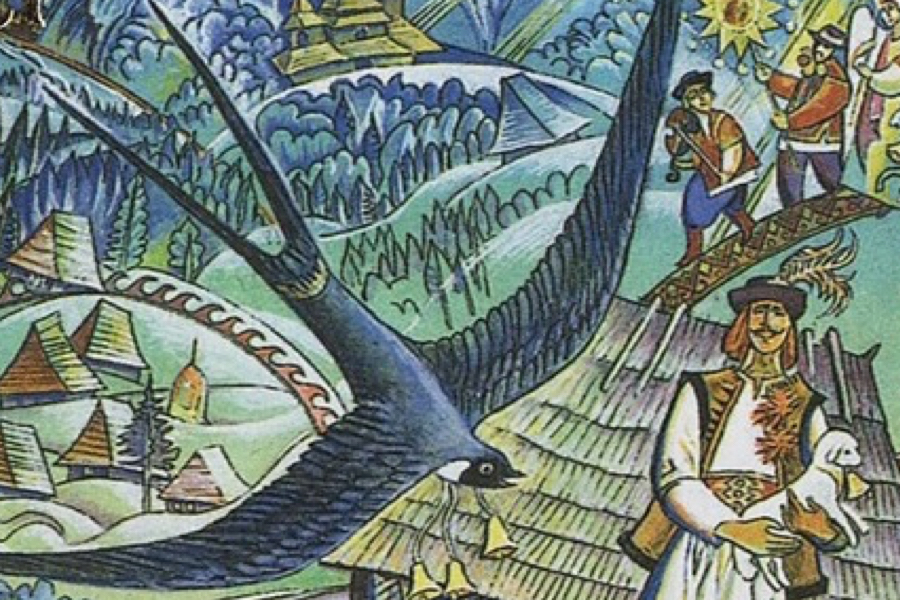
At the turn of the last century, the composer, Mykola Leontovych, arranged a traditional Ukrainian folk song for a choir of students at Kyiv university. The song, sung in March in those days, tells of a swallow heralding the coming of the Spring. But the timing of the seasons changes, and not just because of global warming. With the introduction of Christianity into Ukraine, the Spring festival was replaced by Epiphany and moved to January.
Then, in the aftermath of the first World War, when the victorious nations were gathering to redraw the state boundaries in Europe, Ukraine declared independence and sought to cement its position on the world stage. In 1919, Symon Petliura, the head of the nascent state, commissioned the conductor Oleksandr Hoshyts to assemble a choir for a tour around Europe. He directed them to “sing for the independence of Ukraine”.
The Russian Bolshevik army was advancing on Kyiv and the choir had to be evacuated. They left just one day before the city was captured. Their first concert was given in Stanislaviv in 1919. Shchedryk had its premiere in the Wiener Konzerthaus that same year. Over a three-year tour, performances took place in 74 concert halls, taking in 45 cities in 10 different countries across Europe.
Although Hoshyts’ choir was supported by many members of Europe’s royal families, heads of state, famous academics and music critics, the Western powers did not recognise Ukraine’s independence. In 1921, the country was occupied by Bolshevik Russia and a purge of the Ukrainian intelligentsia began. Mykola Leontovych was killed on 23rd January of that year.
The choir, now homeless, moved to the United States in 1922 and began a tour of the Americas. Over the next two years, they gave 400 performances in 150 cities throughout North and South America. According to an official account, “Everywhere Shchedryk was heard, there were calls for encores”.
Shchedryk was the real hit in our repertoire in all countries for five and a half years.
Aleksandr Hoshyts in his memoirs
The choir remained in New York in the 1930s, and continued to give concerts. Peter Wilhousky, an American conductor of Ukrainian descent, heard Shchedryk at one of these concerts and adapted it for the choir at the high school where he taught. As the schoolchildren would not sing in Ukrainian, Wilhousky wrote a completely new set of lyrics inspired by the “merry tinkle” he heard in the tune. It is this that has given the song the English language title, “Carol of the Bells”, and how it has become associated with the December festival of Christmas.
The song has been performed by innumerable artists, either as Shchedryk or Carol of the Bells. A version by the bluegrass country band, Southern Raised, featured in these pages around four years ago (Carol of the Bells). But today, I’d like to bring your attention to this acoustic guitar rendition by the wonderful Jon Gomm.
This piece of music seems especially appropriate at this time. Not only is the Christmas shopping spree in full swing, it’s also when plans to end the war in Ukraine are being discussed. The ‘solutions’ on the table at the moment are bizarre beyond belief. Those who concocted the plans clearly have no appreciation of the history of Ukraine, nor any idea of what ‘justice’ means. Under international law, Ukraine is a sovereign country. It was invaded by Russia. There is no excuse for that. No arrangement that cedes territory to Russia can be just. As far as Ukraine is concerned, peace without justice spells defeat. And if the world powers allow that, they will be complicit in an act of mindless aggression.
I am waiting for the swallow and the brighter times of Spring, but I fear I will be disappointed.
 Crotchety Man
Those are words spoken so well and thank you for this intriguing story.
LikeLiked by 1 person
I did not know that story, only that it was Ukranian. I love the song and presumably it made its way to Utah to be sung by the Mormon Tabernacle Choir . They appeared on someone’s blog a few years back, in what must be the biggest version with a lot of bells!
My late father-in-law was Ukrainian, one of many who could not return after the Second World War. I have been wearing blue and yellow ribbons ever since the invasion and have a flag in my porch which I bought for the Eurovision song contest that first year. We must not let Ukraine down again.
LikeLiked by 1 person