Or, Eight Tales of Pixie Mischief
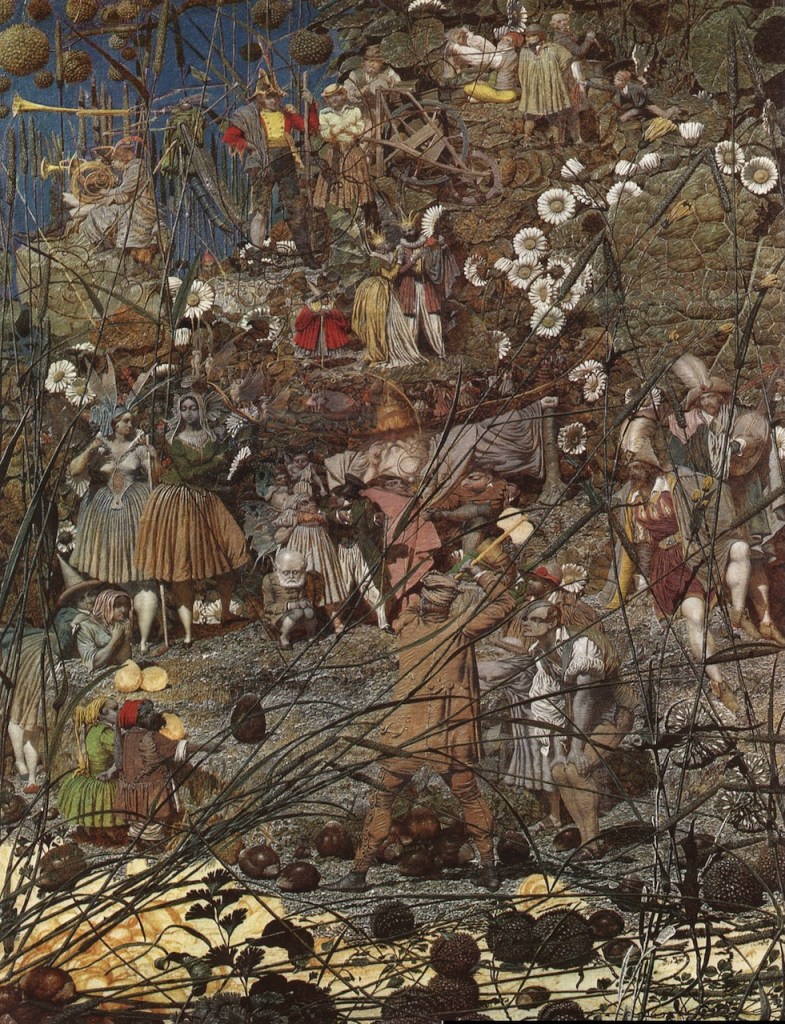
The English painter, Richard Dadd, was born in 1817. His aptitude for drawing was evident early on, and he was admitted to the Royal Academy of Arts at the age of 20. While on a tour of Eastern Europe and the Middle East in 1842, Dadd suffered a profound personality change, and on his return to England he was declared to be of unsound mind. A few months later, he murdered his father and was incarcerated in Bethlem psychiatric hospital. Dadd spent 20 years in that hospital and the rest of his life in Broadmoor high-security psychiatric facility.
Dadd’s doctors treated him “in an enlightened manner”, encouraging him to continue painting. His life and work motivated several of the characters that will be familiar to readers of this blog: Freddie Mercury, Neil Gaiman, Loreena McKennitt, Terry Pratchett. More recently, he inspired Quinn Downton to make his Yellow Sands; Or, Eight Tales of Pixie Mischief album under the artist name of Cries for Colour. And it’s absolutely delightful.
In style, Yellow Sands … is a little upbeat of ambient, a bit deeper than pop, lighter than heavy rock, less serious than classical. It sieves out the wheat from the chaff right across the style spectrum and uses it to bake the tastiest sound cake since lemon meringue pie.
The album starts with the title track. Its opening few bars of mediaeval chant soon give way to a song with a gentle groove driven by fretless bass and oriental percussion. We are very much in Colin Edwin territory (cf. Burnt Belief, Fractal Sextet), and that’s not surprising because Colin himself features prominently throughout the album. This, it turns out, is just the first part of a 52-minute guided tour of myth, magic and Tinkerbell music.
All eight tracks on the album have an enchanting vibe courtesy of Quinn Downton’s drums, keys and compositional skills. But it’s not an exercise for a one-man band. The 16 guest musicians credited on Yellow Sands bring a wide range of instruments: violin, acoustic and electric guitar, bowed and plucked acoustic bass, harmonica, flute, trumpet, saxophone, ukulele, dulcimer, and a few less familiar faerie-land sound generation contraptions. Lead vocals are by ‘Daisy’; three backing vocalists take their turn to add delicate harmonies. And the band leader has mixed them with a light-hearted sense of pixie fun. Or should that be ‘mischief’?
 Crotchety Man